By Zak Blackburn September 21, 2026
For a Harrisburg deli, neighborhood market, bakery, convenience store, or grocery operation with a prepared-food counter, Pennsylvania prepared food sales tax is not a rule that can be reduced to “hot equals taxable, cold equals exempt.”
Pennsylvania generally exempts many grocery-type food purchases, while taxing certain sandwiches, meals, hot foods, soft drinks, prepared beverages, salad-bar items, and other selected foods.
The result can also change depending on whether the sale is made by a food retailer, an eating establishment, or a separately identifiable department within the same business.
That distinction matters at checkout. A customer might buy bread, milk, a cold prepared salad, a hot sandwich, and a soft drink in one trip. The register cannot safely decide that the entire transaction is “grocery” or “prepared food.” Each line needs the correct tax treatment based on Pennsylvania’s rules.
For Harrisburg merchants, the state rate is currently 6%. Pennsylvania adds local sales tax in Allegheny County and Philadelphia, but those additions do not apply to a Harrisburg sale merely because it occurs in Pennsylvania.
The operational lesson is straightforward: determine the legal treatment first, then make the POS reproduce that treatment consistently. The Pennsylvania Department of Revenue’s general sales and use tax guidance provides the statewide rate and exemption framework, while the more specific food rules come from Pennsylvania’s food-and-beverage regulation.
Pennsylvania Prepared Food Sales Tax: The Core Rule
The core Pennsylvania prepared food sales tax rule is that food for human consumption is often exempt when sold as ordinary grocery-type food, but Pennsylvania taxes specified food and beverage sales and broadly taxes food sold from an eating establishment or by a caterer.
A food retailer such as a grocery store, delicatessen, bakery, supermarket, farm market, or convenience store generally receives different treatment from an eating establishment, although selected food items remain taxable even when sold by a food retailer.
Pennsylvania’s regulation expressly defines a food retailer as a business, or identifiable location within a business, engaged in selling grocery-type items for other than immediate consumption. It lists bakeries, pastry shops, doughnut shops, delicatessens, grocery stores, supermarkets, farm markets, and convenience stores as examples.
An eating establishment, by comparison, is a business or identifiable location within a business that holds itself out as selling prepared or ready-to-eat food or beverages for immediate consumption, whether consumption occurs on or off the premises.
Seating is not required. Carryout shops, lunch counters, coffee shops, fast-food operations, cafeterias, pizzerias, snack bars, and similar operations can qualify.
That is the central distinction this article is built around. Product type matters, but so do preparation, sale context, and the identifiable operation making the sale.
Quick answer: What prepared food is taxable in Pennsylvania?
Pennsylvania taxes food sold by an eating establishment or caterer unless a specific exception applies. It also taxes defined “selected food and beverage items” when sold by food retailers, including sandwiches, meals, salad-bar food, hot soup, hot pizza, other hot food, soft drinks, hand-served ice cream products, and hot drinks. Ordinary grocery-type foods sold by qualifying food retailers are generally exempt.
The state’s detailed food and beverage regulation in 61 Pa. Code §60.7 is therefore more useful to a mixed deli or market than a simplistic taxable-food list.
Prepared food vs grocery: verified examples
| Item / Sale Context | Likely Tax Treatment | Why | Official Source |
| Bread sold by a qualifying bakery or grocery retailer | Exempt | Baked goods are grocery-type items | 61 Pa. Code §60.7 |
| Meat or cheese sold by the pound by a delicatessen | Exempt | Regulation’s deli example treats these as nontaxable | 61 Pa. Code §60.7 |
| Prepared cold salad sold by a delicatessen | Exempt | Specifically exempt in the Department’s deli example | 61 Pa. Code §60.7 |
| Hoagie or sandwich sold by a delicatessen | Taxable | Sandwiches are selected food items | 61 Pa. Code §60.7 |
| Hot macaroni and cheese from a deli | Taxable | Hot prepared food is a selected food item | 61 Pa. Code §60.7 |
| Hot barbecued chicken from a deli | Taxable | Explicitly taxable in the deli example | 61 Pa. Code §60.7 |
| Bakery cake sold by a bakery | Exempt | Baked goods sold by food retailer | 61 Pa. Code §60.7 |
| Coffee sold by a bakery | Taxable | Hot drinks are selected items | 61 Pa. Code §60.7 |
| Soft drink sold by a food retailer | Taxable | Soft drinks are selected food/beverage items | 61 Pa. Code §60.7 |
| Grocery food sold from an eating establishment without qualifying separate food-retailer operation | Generally taxable | Eating-establishment rule applies | 61 Pa. Code §60.7 |
This is why a single “Food = exempt” setting is dangerous, but so is a single “Prepared = taxable” setting. Pennsylvania prepared food sales tax decisions need to be mapped to the actual regulatory categories.
PA Sales Tax Ready to Eat Food: What Makes an Item Taxable?
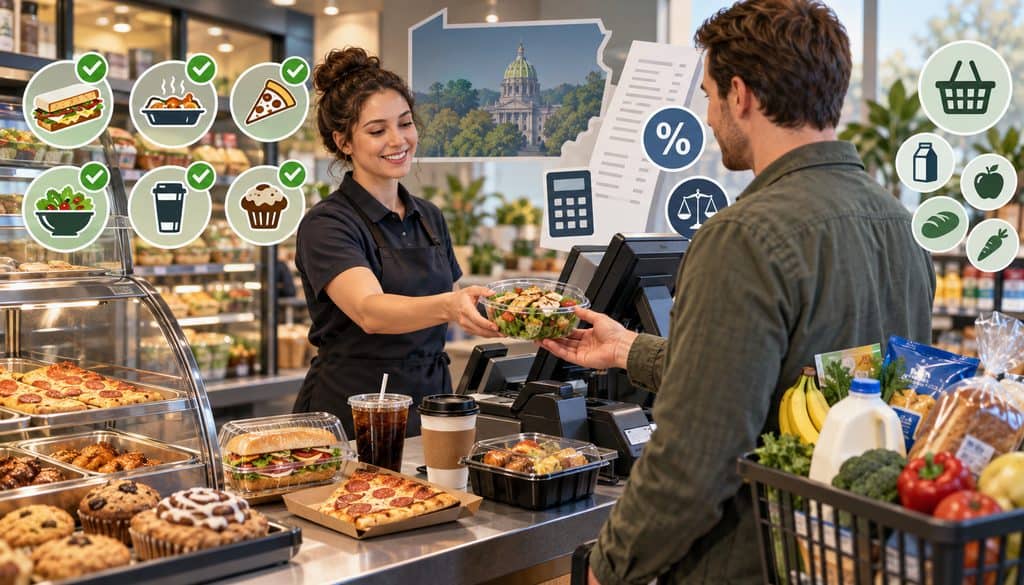
The phrase PA sales tax ready to eat food is useful for search, but Pennsylvania does not apply one universal “ready-to-eat test” to every merchant. The regulation distinguishes eating establishments from food retailers and separately defines selected foods that remain taxable when sold by food retailers.
An eating establishment holds itself out as selling prepared or ready-to-eat food or beverages for immediate consumption. The food can be consumed on the premises or somewhere else. That means takeout does not automatically convert a taxable restaurant-style food sale into an exempt grocery purchase.
For food retailers, the selected-item list is especially important. It includes meals; sandwiches such as hoagies, hamburgers, hot dogs, and similar sandwiches; salad-bar food; hand-dipped or hand-served ice cream and similar products; hot soup; hot pizza; other hot foods such as chicken, pork ribs, and macaroni and cheese; hot coffee, tea, and cocoa; and soft drinks.
So the PA sales tax ready to eat food question should normally be broken into several smaller questions:
- What is the product?
- Has it become one of Pennsylvania’s selected food or beverage items?
- Is the seller operating as a food retailer, an eating establishment, or both?
- If both, where was this particular item sold?
- Are the required separate-location and separate-record conditions being met?
- Does an explicit regulatory example address the product?
Temperature is one factor, but it is not the entire rule. A cold deli salad appears as exempt in Pennsylvania’s delicatessen example. A cold sandwich is still a sandwich and therefore falls within the selected-food definition. That is a particularly useful demonstration of why “cold means grocery” is incorrect.
Grocery Exempt Pennsylvania: What Usually Falls on the Exempt Side?
A search for grocery exempt Pennsylvania often produces oversimplified lists. The more reliable starting point is Pennsylvania’s definition of grocery-type items and its treatment of food retailers.
The regulation gives grocery-type examples including pies, cakes, bread and similar baked goods; fresh fruits and vegetables; canned goods; meat and cheese by the pound; milk in pint, quart, half-gallon, or gallon quantities; certain prepackaged ice cream products; frozen foods; unprepared fish and seafood; bottled honey and syrup; jam; jelly; and similar items.
Food retailers generally do not collect sales tax on ordinary food and beverages unless the item falls within a taxable selected-food category or the sale occurs through an eating establishment operated by the retailer.
Is grocery food exempt in Pennsylvania?
Many ordinary foods sold by a qualifying grocery store, market, bakery, deli, or similar food retailer are exempt from Pennsylvania sales tax.
The exemption is not universal. Sandwiches, hot foods, salad-bar items, soft drinks, hot beverages, meals, and other selected items can still be taxable, and sales from an eating-establishment portion of the business are subject to the eating-establishment rules.
That qualification matters to anyone building a grocery exempt Pennsylvania tax matrix. A gallon of milk, bread, a sandwich, and a fountain soft drink should not automatically inherit the same tax code merely because all four SKUs live under “Food & Beverage” in the inventory system.
Likewise, the exemption is not determined by whether the product has a UPC, whether it is wrapped, or whether a cashier considers it “groceries.” Pennsylvania’s regulation specifically says food can fall within its rules whether or not individually packaged in a sealed wrapper.
Why Seller Type Can Change the Result
The seller distinction is one of the most important—and most easily missed—parts of Pennsylvania prepared food sales tax.
Pennsylvania’s regulation says food and beverage sales by an eating establishment are generally taxable whether prepared or consumed on or off the premises.
Yet the same regulation allows an eating establishment to operate as a food retailer for grocery-type sales if it maintains both a separate department or identifiable location and separate records for those grocery sales.
The regulation’s restaurant/bakery example makes the point unusually clearly. A restaurant that also operates a separately identified bakery, records those bakery transactions separately, and sells bread, cakes, doughnuts, and cookies through that bakery can make exempt bakery sales. Baked goods sold from the restaurant operation remain taxable.
This is not a rule that “restaurants are taxable and grocery stores are exempt.” It is a rule in which the character of the seller or identifiable location can affect how the same grocery-type product is treated.
Does seller type change food taxability in Pennsylvania?
Yes. Pennsylvania distinguishes food retailers from eating establishments. Grocery-type food sold by a qualifying food retailer is generally exempt, while food and beverages sold from an eating establishment are generally taxable.
A business can operate both, but Pennsylvania requires an identifiable separate grocery department or location and separate sales records for an eating establishment to qualify for food-retailer treatment on those grocery sales.
Restaurant vs Grocery vs Deli vs Bakery
| Seller Type | Prepared-Food Exposure | Grocery-Type Items | POS Implication |
| Restaurant/eating establishment | Broadly taxable food-and-beverage sales, subject to specific exceptions | Can qualify for grocery treatment only through required separate food-retailer operation | Do not assume packaged grocery item is exempt without reviewing location/record structure |
| Grocery store | Selected foods remain taxable | Ordinary grocery-type food generally exempt | Mixed taxable/exempt item catalog |
| Deli/market | Sandwiches and hot selected foods taxable; some cold prepared foods can be exempt | Meat/cheese by pound and other grocery items may be exempt | “Deli” cannot safely be one department-level tax flag |
| Bakery | Soft drinks, coffee and certain selected products taxable | Ordinary baked goods generally exempt when sold as food-retailer sales | Bakery SKU mapping must distinguish baked goods from taxable beverages/selected foods |
| Convenience store | Hot sandwiches, soft drinks and other selected items can be taxable | Many packaged foods remain exempt | High mixed-basket exposure |
For restaurant POS tax mapping Harrisburg projects, this distinction is more useful than copying another restaurant’s tax setup. A full-service restaurant, grocery store with a deli, and convenience store with a roller grill can all sell “food,” but their catalogs need different item-level logic.
Deli Sales Tax PA: Hot Bar, Cold Cases, Sandwiches, and Prepared Salads
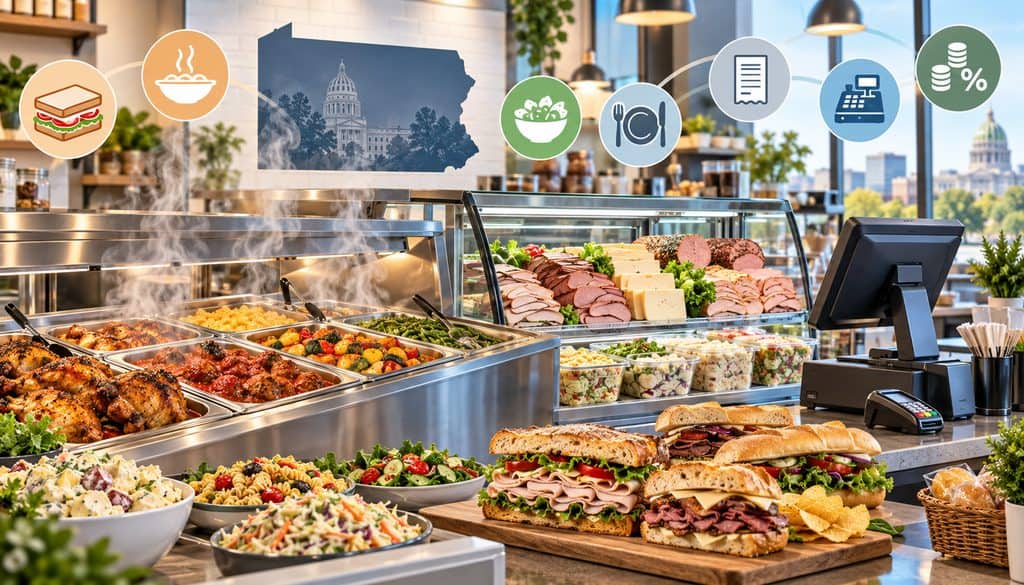
The deli sales tax PA boundary is where Pennsylvania’s regulation becomes especially practical because it provides an actual delicatessen example.
In that example, a deli sells meat and cheese by the pound, hoagies, sandwiches, prepared cold salads, hot beans, hot macaroni and cheese, cold hard-boiled eggs, and hot barbecued chicken.
Pennsylvania treats the meat and cheese by the pound, cold prepared salads, and cold hard-boiled eggs as exempt. Hoagies, sandwiches, hot beans, hot macaroni and cheese, and hot barbecued chicken are taxable.
Are deli foods taxable in PA?
Some are and some are not. Pennsylvania’s deli example exempts meat and cheese sold by the pound, prepared cold salads, and cold hard-boiled eggs, but taxes hoagies, sandwiches, hot beans, hot macaroni and cheese, and hot barbecued chicken. A deli therefore needs SKU-level or product-level tax mapping rather than a single tax setting for the whole department.
That official example is why deli sales tax PA configuration should not be based only on whether employees performed preparation.
Hot bar
A typical supermarket hot bar contains precisely the kinds of products Pennsylvania includes among selected food items: hot chicken, macaroni and cheese, and similar hot food. Salad-bar food is also expressly listed as selected food.
If hot-bar products are sold by weight, that pricing method does not itself turn them into exempt grocery food. The POS should apply the appropriate tax flag to the item or PLU used at the scale or register.
For a Harrisburg grocer, the high-risk configuration is one generic “Prepared Foods” PLU used for hot chicken at noon and cold exempt deli salad later in the day. The same button cannot produce two legally different results unless the POS has additional item or modifier logic.
Cold bar and salad bar
Do not confuse a prepared cold deli salad with food sold from a salad bar. Pennsylvania specifically includes food from salad bars in selected food items, while separately giving an example in which prepared cold salads sold by a delicatessen are exempt.
That distinction illustrates why both the product and sale format need to be documented.
Sandwiches
Pennsylvania expressly lists sandwiches—including hoagies, hot dogs, hamburgers, and similar sandwiches—as selected food items. The deli example taxes hoagies and sandwiches without limiting the result to hot sandwiches.
Accordingly:
- a hot made-to-order sandwich is taxable;
- a cold deli sandwich remains within the selected sandwich category;
- prepackaging alone does not automatically convert a sandwich into exempt grocery food;
- sliced meat and cheese sold by the pound can receive different treatment from the sandwich assembled from those ingredients.
That last comparison is the essence of the Pennsylvania prepared food sales tax boundary.
Bakery, Fountain Drinks, Bottled Drinks, and Catering Trays
Bakery items
Pennsylvania’s bakery example treats baked goods and prepackaged ice cream sold by the bakery as exempt but taxes soft drinks, coffee, and hand-dipped ice cream.
Bread, cakes, pies, doughnuts, cookies, and similar bakery products therefore should not be automatically mapped to the same code as coffee or soft drinks in a bakery’s item master.
The seller-context rule still matters. Pennsylvania’s separate restaurant/bakery example says baked goods sold through the restaurant operation are taxable, while baked goods sold through a separately identified bakery with separate records are exempt.
A decorated birthday cake from the qualifying bakery counter and a slice of cake sold as part of the restaurant operation may therefore require different analysis even though both came from the same kitchen.
Fountain drinks versus bottled beverages
Pennsylvania defines “soft drink” broadly enough to cover many sodas and similar beverages regardless of whether they are carbonated. Soft drinks are selected food and beverage items and are taxable when sold by a food retailer.
That makes a fountain soda taxable, but businesses should not translate that into “every bottle in the beverage cooler is taxable.” The beverage category matters.
The regulation’s soft-drink definition excludes, among other things, qualifying fruit or vegetable juice containing at least 25% natural juice, as well as milk and certain noncarbonated milk-derivative drinks. Coffee, tea, and cocoa are excluded from the “soft drink” definition but hot coffee, tea, and cocoa are separately included as selected food items.
The right POS field is therefore not “bottle versus fountain.” It is the legally relevant beverage classification.
Coffee and other prepared beverages
A bakery’s coffee is taxable under Pennsylvania’s example. Hot drinks such as coffee, tea, and cocoa are selected food items, and the regulation also taxes coffee in its food-retailer examples.
For a mixed retailer, that means a coffee counter may need taxable beverage codes even when the neighboring bakery shelves contain exempt products.
Catering trays and party platters
A true catering transaction is different from ordinary grocery retail. Pennsylvania defines a caterer as a business providing prepared or ready-to-eat food and beverages for immediate consumption at a specific meal, affair, or social function, normally involving serving utensils. Sales of food and beverages by caterers are taxable.
A deli should therefore avoid assuming that every tray inherits the tax treatment of its component grocery products. A sandwich platter already includes selected sandwiches. A catered meal may fall under the caterer rule. A simple unprepared grocery arrangement can present a different question.
Where a fruit tray, vegetable tray, cheese tray, or other platter does not fit an explicit published example, document the facts and confirm treatment rather than improvising from appearance alone.
Edge cases at a glance
| Item | Restaurant / Eating Establishment | Deli / Market Food-Retailer Sale | Grocery Food-Retailer Sale | Key Point |
| Bread | Generally taxable unless qualifying separate grocery operation | Generally exempt as grocery-type baked good | Generally exempt | Seller/location can change result |
| Cold sandwich | Taxable | Taxable | Taxable if sold as selected sandwich item | Temperature does not remove sandwich classification |
| Prepared cold deli salad | Taxable if sold from eating establishment | Exempt in PA deli example | Review food-retailer treatment | Do not equate all prepared food with taxable food |
| Salad-bar food | Taxable | Taxable | Taxable | Selected food item |
| Hot chicken | Taxable | Taxable | Taxable | Selected hot food |
| Bakery cake | Taxable from eating establishment; possible separate bakery exception | Generally exempt in qualifying bakery/food-retailer context | Generally exempt | Department/location records matter |
| Soft drink | Taxable | Taxable | Taxable | Selected beverage |
| Coffee | Taxable | Taxable | Taxable when sold as hot selected beverage | Distinct from ordinary grocery beverage logic |
Restaurant POS Tax Mapping Harrisburg: Building the Item-Level Tax Matrix
The legal analysis is only half the job. Restaurant POS tax mapping Harrisburg becomes operationally important when a market, deli, bakery, or convenience store sells taxable and exempt food through the same checkout.
The recommended architecture is a taxability matrix that sits between Pennsylvania law and the POS product catalog.
| SKU / Category | PA Treatment | POS Tax Code | Rule Source | Last Reviewed |
| White sandwich bread loaf | Exempt grocery | PA-FOOD-EXEMPT | 61 Pa. Code §60.7 | September 21, 2026 |
| Deli turkey by pound | Exempt grocery | PA-FOOD-EXEMPT | §60.7 deli example | September 21, 2026 |
| Prepared cold deli salad | Exempt in deli example | PA-FOOD-EXEMPT | §60.7 deli example | September 21, 2026 |
| Cold hoagie | Taxable | PA-FOOD-TAX | Selected sandwich rule | September 21, 2026 |
| Hot chicken | Taxable | PA-FOOD-TAX | Selected hot food rule | September 21, 2026 |
| Bakery cake | Exempt where qualifying bakery sale | PA-FOOD-EXEMPT | Bakery example | September 21, 2026 |
| Soft drink | Taxable | PA-BEV-TAX | Selected beverage rule | September 21, 2026 |
| Hot coffee | Taxable | PA-BEV-TAX | Hot beverage rule | September 21, 2026 |
The actual internal tax-code names are software choices. Pennsylvania does not require those labels. What matters is that the resulting transaction and records accurately distinguish taxable and nontaxable sales.
How should a deli or market map sales tax in the POS?
Build the POS from an item-level taxability matrix. Classify each SKU by product type, preparation, seller or department context, and Pennsylvania rule; then assign the corresponding tax code. Keep separate codes for exempt grocery and taxable food where needed, test mixed baskets, and retain the source used for each decision. Do not use one universal “Deli” or “Food” tax flag.
A mixed food seller needs POS inventory, online-ordering, and reporting controls that keep item records consistent across sales channels. If an exempt grocery SKU is mapped correctly at the counter but differently online or at a kiosk, the tax problem has not actually been solved.
Department-level tax mapping is often too crude
“Deli” can contain:
- exempt meat by the pound;
- exempt prepared cold salad in Pennsylvania’s example;
- taxable sandwiches;
- taxable hot soup;
- taxable hot chicken.
“Bakery” can contain exempt cakes and bread but taxable coffee and soft drinks.
“Convenience food” can contain exempt chips or packaged foods beside a taxable heated sandwich. Pennsylvania’s service-station example specifically treats frozen ice cream products, small bags of potato chips, and candy as exempt while taxing heated sandwiches.
A department can remain useful for reporting, but it should not automatically control the tax flag when its contents have multiple treatments.
Modifiers and preparation changes
Modifiers need attention where they change the underlying taxable sale. A sandwich remains in the selected sandwich category whether a customer adds cheese, removes onions, or chooses a different condiment.
A more difficult case arises when one catalog item can be sold in materially different conditions—for example, when a product can be sold unprepared through a grocery department or prepared through an eating-establishment counter. Instead of letting the cashier toggle tax manually, consider separate SKUs or clearly controlled preparation variants.
POS vendor defaults are not tax authority
Do not assume a POS vendor’s generic “Food,” “Grocery,” or “Prepared Food” tax category matches Pennsylvania law.
The merchant remains responsible for reporting taxable sales correctly. Pennsylvania’s tax return data itself separates gross sales, net taxable sales, and actual tax collected.
A POS default is therefore an implementation starting point, not a legal conclusion.
How to Test Mixed Baskets Before Going Live
Mixed-basket testing is where configuration errors become visible.
Imagine a Midtown Harrisburg market customer buying:
- one loaf of bread for $4.00;
- one gallon of milk for $4.50;
- one hot deli sandwich for $10.00;
- one qualifying bottled juice for $3.00;
- one bakery cake for $18.00.
Assume for this illustration that the bread, milk, qualifying juice, and cake are sold through the qualifying food-retailer operation and that the juice does not meet the soft-drink definition. The sandwich is taxable because sandwiches are selected food items.
Mixed basket example
| Item | Price | Taxable? | PA Tax at 6% |
| Bread loaf | $4.00 | No | $0.00 |
| Gallon of milk | $4.50 | No | $0.00 |
| Hot sandwich | $10.00 | Yes | $0.60 |
| Qualifying bottled juice | $3.00 | No, under stated assumptions | $0.00 |
| Bakery cake | $18.00 | No, under qualifying bakery/food-retailer context | $0.00 |
| Total | $39.50 | $0.60 |
The example is illustrative, but its architecture is the point. Tax attaches to the taxable transaction line; the POS should not tax $39.50 merely because the basket includes a sandwich, nor exempt the whole basket because most items are grocery food.
This is another reason restaurant POS tax mapping Harrisburg should be tested using realistic deli-and-market baskets rather than a single $1 test item.
A practical POS test script
- Ring an exempt grocery item by itself.
- Ring a taxable prepared food item by itself.
- Ring both in one mixed basket.
- Refund the taxable item and confirm the related tax reverses.
- Apply an authorized discount and verify the system calculates the resulting tax correctly under the configured rules.
- Test a sandwich or other prepared-food combo.
- Test the same ordering channel used for takeout.
- Test a deli or catering tray using its actual SKU.
- Repeat the basket in online ordering.
- Repeat it through any kiosk or self-ordering interface.
POS testing record
| Test Basket | Expected Result | Actual POS Result | Pass/Fail |
| Bread only | No PA sales tax | ______ | ______ |
| Hot sandwich only | 6% PA tax in Harrisburg | ______ | ______ |
| Bread + sandwich | Tax only sandwich line | ______ | ______ |
| Taxable-item refund | Reverse related sales tax | ______ | ______ |
| Bakery item + coffee | Apply respective bakery/beverage rules | ______ | ______ |
| Deli salad + sandwich | Exempt salad / taxable sandwich under cited deli example | ______ | ______ |
| Online mixed basket | Match store mapping | ______ | ______ |
| Catering/party-tray test | Match documented tax determination | ______ | ______ |
Before relying on a new configuration, confirm that the POS can preserve product-level tax settings while maintaining usable inventory and transaction reporting. That becomes especially important when one basket contains exempt grocery products alongside taxable sandwiches, hot food, or beverages.
Tax overrides
Manual overrides should be exceptional, controlled, and logged.
Cashiers should not be asked to interpret PA sales tax ready to eat food rules every time a customer asks whether a deli item is taxable. The system should already contain the approved decision.
A reasonable operating model is:
- cashier uses the configured SKU;
- manager handles genuine exceptions;
- overrides require a reason code;
- override reports are reviewed periodically;
- recurring overrides trigger an item-master review.
New-item workflow
For every new SKU:
create SKU → assign product type → determine seller/location context → review PA taxability → record source → assign POS tax code → test transaction → publish to every relevant channel
This workflow is particularly valuable for seasonal bakery items, new grab-and-go meals, rotating hot-bar dishes, and specialty-market imports.
Multi-location and omnichannel consistency
If a business has more than one store, tax mapping can drift when local managers create products independently.
Use one controlled product master where possible. Online ordering, kiosks, delivery menus, and store registers should point to the same approved taxability decision.
Pennsylvania also addresses taxable food transactions facilitated through third-party delivery businesses, making it important to verify that taxable menu lines and related settings remain aligned outside the physical register.
Do not assume the marketplace’s food category is automatically correct.
What a Pennsylvania Sales Tax Audit May Sample
Bad tax mapping becomes expensive when an audit reconstructs what should have been reported.
Pennsylvania requires sales-and-use-tax records that support the amounts on returns and distinguish taxable from nontaxable transactions.
The Department’s audit manual says auditors may examine source documents, journals, ledgers, schedules, returns, and other records used to record sales and purchases. It also permits complete examinations or test methods covering a representative portion of business activity.
The manual states that sales-tax records generally must be maintained for three years from the end of the calendar year to which they pertain, tied to the statutory assessment limitation discussed in the manual. Special circumstances can require separate analysis, so businesses should not interpret that sentence as individualized audit-lookback advice.
Records that can matter
| Record | What It Can Help Establish | Audit Use |
| POS transaction detail | Which SKUs were sold and whether tax was charged | Reconstruct taxable/nontaxable sales |
| Daily/monthly sales reports | Gross sales, taxable sales, tax collected | Reconcile returns |
| Sales journals/ledgers | Accounting treatment | Cross-check POS totals |
| Product catalog/item master | SKU descriptions and tax flags | Identify systematic miscoding |
| Purchase invoices | Product mix and resale activity | May support alternative audit methods |
| Bank statements | Deposits and gross-receipt reconciliation | Completeness testing |
| Merchant processor statements | Card volume, refunds, settlements | Cross-check reported sales |
| Exemption documentation | Basis for exempt transactions where relevant | Support nontaxable treatment |
| Tax returns | What was actually reported | Compare with source records |
| Delivery-platform reports | Off-premise sales volume | Reconcile third-party orders |
The Department’s historical restaurant audit guidance specifically identified transaction receipts, credit-card slips, void/cancel documentation, exemption certificates, bank statements, daily and monthly sales reports, merchant credit-card statements, Forms 1099-K, and third-party delivery statements among the records expected in that initiative.
Although that initiative was restaurant-specific and dated, it illustrates why card settlement data can be a useful corroborating record rather than the source of item-level taxability.
A merchant statement can tell an auditor that $82,000 settled to cards. It cannot tell the auditor how much of those sales represented exempt milk, taxable sandwiches, refunded orders, tips, or another category.
During a tax reconciliation, real-time POS reporting and transaction monitoring can help connect taxable sales, exempt sales, refunds, and card volume back to the amounts reported for the filing period. Processor totals can corroborate gross payment activity, but they do not determine whether an individual deli or grocery SKU was taxable.
Audit sampling
Pennsylvania’s sales-and-use-tax audit manual allows test methods and describes several sampling approaches. When adequate complete records are unavailable, the manual also describes prospective-record methods and estimating taxable sales using purchase records under specified circumstances.
The critical lesson is not to guess what sample period an auditor will choose. It is to preserve enough reliable records that the merchant’s taxable-versus-exempt treatment can be reconstructed.
If a sample reveals the same incorrect tax flag on hundreds of deli transactions, a one-SKU configuration error can become much larger than the value of the individual tickets reviewed.
How an assessment can arise
Conceptually, the audit process can look like this:
review records → identify sales that should have been taxable → determine audited taxable sales using an authorized audit method → compare with reported taxable sales → calculate additional tax → apply applicable interest and penalties
Pennsylvania’s audit manual describes applying audited taxable-sales calculations against reported taxable sales in certain estimating procedures. Exact methodology depends on the audit facts and records available.
Undercollection is not solved by pointing to the POS
A merchant cannot safely treat “the software did it” as proof that the return was correct.
The Pennsylvania filing system expects the business to report gross sales, net taxable sales, and actual sales tax collected.
If a taxable $10 sandwich was configured as exempt, the economic problem is not merely that the customer was charged $0.60 too little. The merchant’s reported taxable-sales base may also be wrong.
Overcollection matters too
The opposite configuration error is also undesirable. A system that charges tax on an exempt grocery sale may create customer issues and tax-accounting complications.
Do not fix an overcollection problem by leaving the incorrect tax flag in place. Correct the configuration, quantify historical transactions, and obtain appropriate Pennsylvania-specific advice regarding amounts previously collected.
Fixing Historical Food-Tax Misclassification
Finding an incorrect tax flag is useful, but changing it today addresses only future transactions.
This is where pennsylvania prepared food sales tax cleanup should become a separate accounting project.
What should I do if my POS taxed food incorrectly?
Correct the item mapping prospectively, but separately investigate the historical period. Identify affected SKUs and dates, quantify sales and tax collected, compare those amounts with filed Pennsylvania returns, preserve the rule supporting the corrected treatment, and determine with a qualified adviser or the Pennsylvania Department of Revenue whether amended returns, payments, credits, or another correction process applies.
A strong cleanup workflow is:
- Identify the affected SKUs: Export every item that used the incorrect tax code.
- Determine when the bad flag began: Use catalog history, POS configuration logs, menu-launch dates, or product-creation dates where available.
- Separate undercollection from overcollection: These are not the same problem and may require different handling.
- Quantify affected sales: Use transaction-level data rather than multiplying current sales by an assumed historical percentage when detailed records exist.
- Compare with returns already filed: Reconcile gross sales, taxable sales, and tax collected by filing period.
- Document the correct tax authority: Record the regulation, Department guidance, or written determination supporting the new flag.
- Review correction requirements: Determine whether amended returns or other corrective filings apply to the affected periods.
- Correct the product master: Change the tax flag with a documented effective date.
- Push the change to every channel: Store POS, kiosk, mobile ordering, website, delivery integrations, and alternate locations should be checked.
- Retest: Repeat exempt-only, taxable-only, mixed-basket, refund, discount, and applicable catering tests.
- Preserve the before-and-after records: Do not erase evidence showing when the problem was discovered and corrected.
Pennsylvania’s sales-tax file specifications expressly recognize an amended return type, confirming that sales-tax return data can be filed as original or amended. Businesses needing to address previous reporting can use the Department’s business-tax filing and amendment framework together with professional advice appropriate to the facts.
Illustrative undercollection example
Suppose review shows that $40,000 of taxable food sales had been mapped as exempt.
At Harrisburg’s current 6% Pennsylvania rate:
$40,000 × 6% = $2,400
That $2,400 is an illustration of potential base tax associated with the miscoded sales before considering any applicable interest, penalties, credits, procedural issues, or other facts. It is not an estimate of a particular merchant’s final liability.
The example shows why a tiny SKU checkbox can become a material accounting issue.
Voluntary disclosure is not a universal cleanup shortcut
Pennsylvania has a Voluntary Disclosure Program for eligible businesses or individuals who recently discover Pennsylvania tax obligations, but eligibility has significant restrictions.
For example, the Department states that a taxpayer generally does not qualify for a particular tax type if currently or previously registered for that tax or if the Department has already contacted or investigated the taxpayer.
A registered Harrisburg food seller that simply miscoded several existing products therefore should not assume voluntary disclosure is available. Review the actual correction route that applies to the business.
SKU correction log
| SKU | Old Tax Flag | Correct Tax Flag | Effective Date | Source |
| Deli salad | Taxable | Exempt in cited deli context | ______ | 61 Pa. Code §60.7 |
| Cold hoagie | Exempt | Taxable | ______ | Selected sandwich rule |
| Coffee | Exempt | Taxable | ______ | Hot beverage rule |
| Bakery bread | Taxable | Exempt in qualifying food-retailer context | ______ | Grocery/bakery rule |
Common Prepared-Food Tax Mapping Mistakes
The recurring problem in deli sales tax PA is not usually arithmetic. Six percent is easy to calculate. Classification is where systems fail.
| Mistake | Tax / Audit Risk | Better Approach |
| Marking every deli SKU taxable | Exempt deli/grocery sales may be overtaxed | Map each product category against PA rule |
| Marking the whole grocery store exempt | Sandwiches, hot foods, soft drinks and other selected items may escape tax | Maintain taxable selected-food codes |
| Treating cold as automatically exempt | Cold sandwiches and salad-bar food can remain taxable | Review product classification and context |
| Copying restaurant settings into a market | Food-retailer exemptions may be lost | Determine seller/location status first |
| Ignoring seller type | Same grocery-type item can receive different treatment | Document food-retailer vs eating-establishment location |
| Taxing every bottled and fountain beverage identically | Beverage definition may differ by product | Map beverage category, not container alone |
| Applying tax at basket level | Mixed tickets become over- or undertaxed | Apply item-level tax flags |
| Never testing combos or refunds | Hidden configuration errors remain | Maintain tax test cases |
| Trusting vendor defaults | Generic food categories may not reflect PA rules | Perform Pennsylvania-specific review |
| Quietly fixing mapping without historical review | Prior-period exposure remains unidentified | Quantify history separately |
Pennsylvania Prepared Food Sales Tax POS Checklist
Use this Pennsylvania prepared food sales tax checklist when opening a new food operation, changing POS systems, adding a prepared-food department, or cleaning up an inherited catalog.
- Export the complete food-item catalog.
- Separate grocery-type and prepared-food categories.
- Identify the seller or department context for each category.
- Verify the current Pennsylvania food-tax rules.
- Confirm the current state sales-tax rate.
- Review hot prepared foods.
- Review cold prepared foods.
- Review sandwiches separately.
- Review deli meat and cheese sold by weight.
- Review prepared cold deli salads.
- Review salad-bar products.
- Review bakery products.
- Review fountain and other soft drinks.
- Review bottled and canned beverages by beverage type.
- Review coffee and hot beverages.
- Review catering and party trays.
- Review grab-and-go products.
- Review combos and bundles.
- Review modifiers that change the sale configuration.
- Assign item-level tax codes.
- Record the Pennsylvania rule supporting each category.
- Test an exempt-only basket.
- Test a taxable-only basket.
- Test a mixed basket.
- Test a refund.
- Test discounts and coupons under the merchant’s documented configuration.
- Test online ordering.
- Test kiosks and mobile ordering.
- Restrict manual tax overrides.
- Train managers on escalation rather than tax-law interpretation.
- Review new and seasonal SKUs periodically.
- Identify historically miscoded items.
- Quantify affected sales by period.
- Compare historical results with filed returns.
- Review amended-return options where necessary.
- Correct future mapping.
- Keep test results and taxability matrices with supporting tax records.
Practical 23-step POS tax-mapping workflow
- Export the full item catalog.
- Group products by actual product type.
- Identify the seller, counter, or department through which each is sold.
- Pull current Pennsylvania authority.
- Assign an approved taxability category.
- Record the authority next to that decision.
- Map the corresponding POS tax code.
- Review modifiers and preparation variants.
- Review bundles and combos.
- Review online-order SKUs.
- Review kiosk and mobile-menu mappings.
- Run an exempt-only basket.
- Run a taxable-only basket.
- Run a mixed basket.
- Run a refund.
- Test the merchant’s discount setup.
- Test catering or party-tray SKUs.
- Document expected and actual results.
- Train managers on the approved item structure.
- Lock down unnecessary manual overrides.
- Investigate historical miscoding.
- Correct affected prior reporting where required.
- Retain the taxability matrix and testing documentation with tax records.
That is the operational heart of restaurant POS tax mapping Harrisburg for a mixed retailer. Legal taxability belongs in the tax matrix; the software’s job is to execute it consistently.
Questions to ask a CPA or Pennsylvania Department of Revenue
For unusual items, ask specific questions rather than “Is our deli taxable?”
- Does our seller or department classification change this item’s treatment?
- Is this item one of Pennsylvania’s selected foods?
- Does heating or preparation change its classification?
- How is this specific deli product treated?
- Does the bakery rule apply to our sales layout and recordkeeping?
- Does this beverage meet Pennsylvania’s soft-drink definition?
- How should this bottled beverage be classified?
- How should this specific party tray be treated?
- Are we operating a separate qualifying food-retailer department?
- What records should support our tax mapping?
- How should previously under-taxed transactions be corrected?
- How should previously over-taxed transactions be handled?
- Does an amended sales-tax return apply to these periods?
- What audit period and record-retention rules apply to our facts?
Frequently Asked Questions
What is Pennsylvania prepared food sales tax?
Pennsylvania prepared food sales tax refers to the state’s sales-tax treatment of meals, selected prepared foods and beverages, eating-establishment sales, and catering sales. Pennsylvania’s state rate is currently 6%. Many ordinary grocery foods are exempt, but the result depends on the item and selling context.
What counts as ready-to-eat food in Pennsylvania?
For PA sales tax ready to eat food, start with Pennsylvania’s eating-establishment and selected-food definitions. Eating establishments sell prepared or ready-to-eat food for immediate consumption, while selected foods include meals, sandwiches, salad-bar products, hot soup, hot pizza, other hot food, hot beverages, soft drinks, and certain hand-served frozen products.
Is grocery food exempt from Pennsylvania sales tax?
Many ordinary grocery-type food items sold by food retailers are exempt. Pennsylvania lists examples such as bread, cakes, produce, canned goods, meat and cheese by the pound, certain quantities of milk, frozen foods, and unprepared seafood. Selected food and beverage items can still be taxable.
Is hot food always taxable in Pennsylvania?
Hot prepared foods such as hot soup, hot pizza, hot chicken, ribs, macaroni and cheese, and similar hot food are included among Pennsylvania’s selected food items. But using “hot equals taxable” as the entire food-tax rule is still incorrect because other products, such as cold sandwiches and salad-bar food, can also be taxable.
Are cold deli sandwiches taxable in PA?
Yes, sandwiches are included in Pennsylvania’s selected-food definition, and the state’s delicatessen example taxes hoagies and sandwiches without limiting that treatment to hot sandwiches.
Is sliced deli meat taxable in Pennsylvania?
Pennsylvania’s delicatessen example treats meat and cheese sold by the pound as exempt. The transaction should still be mapped according to the actual deli/food-retailer facts rather than generalized from another type of establishment.
Are bakery items taxable in Pennsylvania?
Baked goods sold by a qualifying bakery or food retailer are generally exempt under Pennsylvania’s examples. A bakery’s soft drinks and coffee are taxable. Baked goods sold through an eating establishment can be taxable unless the operation qualifies for the regulation’s separate food-retailer treatment.
Are fountain drinks taxable in Pennsylvania?
A typical fountain soft drink is taxable because Pennsylvania treats soft drinks as selected food and beverage items. The precise beverage classification matters because the regulation excludes certain beverages from the soft-drink definition.
Are bottled drinks taxable in Pennsylvania?
Not all bottled beverages have identical treatment. A bottled product that meets Pennsylvania’s soft-drink definition is taxable as a selected beverage, while qualifying milk and certain fruit or vegetable juices fall outside that definition. Review the actual beverage rather than using packaging alone.
Are catering trays from a deli taxable?
Some clearly are—for example, sandwich platters contain selected sandwiches, and true catering sales are taxable under Pennsylvania’s caterer rule. Other trays may require item-specific analysis. Do not assume every fruit, vegetable, meat, cheese, or deli tray follows one universal treatment.
Conclusion
Pennsylvania food taxability is more nuanced than a hot-versus-cold rule. Grocery-type products sold through a qualifying food retailer can be exempt, while sandwiches, hot prepared foods, salad-bar products, soft drinks, hot beverages, meals, and other selected items can be taxable.
A seller’s operating context can matter as well, particularly when a grocery store, deli, bakery, or other market contains an identifiable eating establishment—or when an eating establishment also operates a qualifying separate grocery department.
For Harrisburg mixed-food sellers, that complexity belongs in the product master, not in a cashier’s memory. Item-level tax codes, a documented Pennsylvania taxability matrix, controlled overrides, and realistic mixed-basket testing make the POS reflect the rule consistently.
Bad tax flags can also become historical tax issues. An audit may reveal systematic undercollection that began with a single incorrect SKU setting. Correcting the system going forward is essential, but the affected earlier periods should be reviewed separately.
The strongest approach is therefore both legal and operational: verify the item’s Pennsylvania treatment, document why, configure it once, test it across every sales channel, and preserve enough records to explain that decision later.